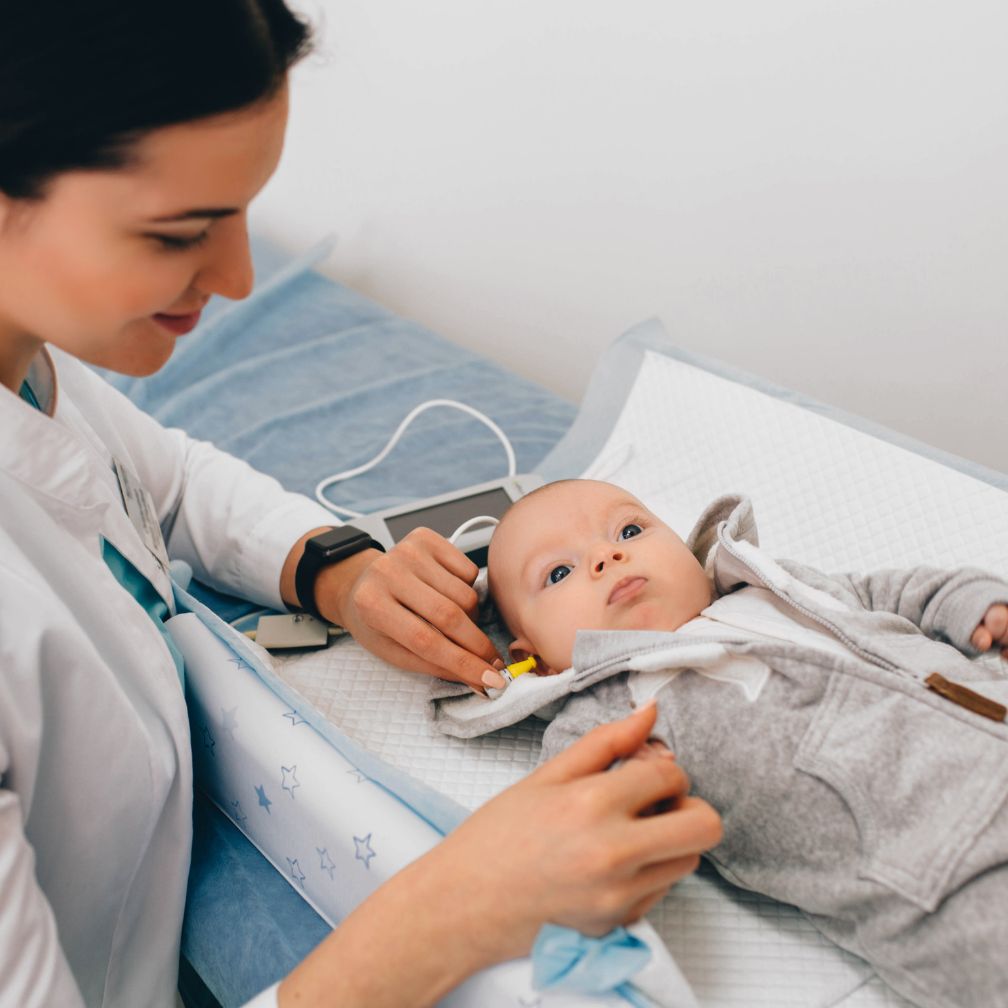
For newly minted parents, learning that their baby exhibits auditory issues inevitably feels heartbreaking and frightening. The reassuring truth is that by applying prompt testing and therapeutic help, young children with hearing deficits are able to succeed. Truly, these infants routinely acquire speech capabilities, relational skills, and strong connections across their social sphere, securing a prosperous life!
Choosing modern hearing aids and surgical cochlear implants yields two reliable clinical methods for helping babies with hearing impairment. Below, our guide evaluates their operational details so you can identify the most suitable choice for your baby.
Demystifying Hearing Deficits in Newborns
Congenital hearing impairment in infants can develop due to diverse root causes, such as:
- Genetic factors (even without an established family history)
- Harmful in-utero viral infections such as cytomegalovirus (CMV) and rubella cases
- Intrapartum events, featuring fetal oxygen deprivation or early delivery
- Specific therapeutic drugs administered within hospital neonatal intensive units
What stage carries the most weight? Early diagnostic testing. As a result, babies within American hospitals complete screening procedures before heading home. Prominent pediatric hearing specialists implement the official “1-3-6” target timetable:
- Initial screening executed inside 30 days of life
- Official medical diagnosis secured within 3 months of birth
- Clinical intervention (utilizing corrective devices or speech habilitation) commenced inside 180 days post-birth
Reaching these structural checkpoints offers infants their most promising outcome regarding speech acquisition, language mastery, and intellectual development. If you want guidance on these diagnostic stages, your pediatrician will gladly offer support!
Wearable Hearing Aids in Infant Care
For infants diagnosed with mild to severe hearing deficits, specialized hearing aids usually function as the initial care standard. These small, external hearing devices amplify acoustic waves, helping infants pick up human speech and natural environmental sounds with clarity.
Infant-adapted hearing aids function as:
- Completely safe for deployment on babies just a few weeks after birth
- Manufactured with pliable, soft ergonomic molds that change as the child grows
- Built featuring locking battery compartments and child-focused protective mechanisms
- Individually configured by a trained pediatric audiology specialist to align with your baby’s exact hearing needs
As your child matures, hearing instruments necessitate frequent maintenance to guarantee ideal ear-canal fit and maximum performance.
Understanding Cochlear Implantation for Babies
If a baby experiences severe to profound sensorineural auditory loss while getting minimal improvement from hearing aids, a cochlear implant is often recommended. Differing from external acoustic hearing aids, modern cochlear implants:
- Are positioned within the inner ear through a surgical process bypassing non-functional outer hair cells
- Successfully bypass non-working components inside the cochlear pathway
- Transform environmental audio into targeted electrical signals that activate auditory nerve fibers directly
Surgical cochlear devices stand as:
- Officially sanctioned by the FDA for young children aged 9 to 12 months and older
- Most successful when paired with early habilitation programs and dedicated family support
- Prescribed solely following a comprehensive diagnostic assessment by a certified audiologist and otolaryngologist
This process includes imaging, objective hearing assessments, and conversations about long-term expectations and outcomes.
Comparing Hearing Aids and Cochlear Implants: Key Differences
- Mild to severe hearing loss targets Hearing Aids; Severe to profound levels of loss demand Cochlear Implants
- Non-Invasive acoustic positioning: Hearing Aids; Invasive surgical placement: Cochlear Implants
- Sound processing amplification: Hearing Aids; Converts Sound Electrical Signals: Cochlear Implants
- Usage can begin in early infancy: Hearing Aids; Starts at 9-12 Months: Cochlear Implants
Final Takeaways: Navigating Infant Hearing Solutions
When your child is diagnosed with auditory deficits, remember that proven treatment choices and plenty of support. By partnering with skilled pediatric auditory specialists, many children go on to develop language skills that are on par with their peers.
Whether your child is a candidate for hearing aids or cochlear implants, early action creates a profound lifelong advantage.
Have you got specific questions concerning your newborn’s hearing abilities? Contact our clinical team today for a complete diagnostic review and tailor-made care roadmap.